Wednesday, February 11, 2015

L'artiste Brenda Louie , par Hussein HUSSEIN

L'artiste Brenda Louie 

C’est à Toi Shan, un village d’une des provinces de Chine, que verra le jour Brenda Louie en 1953, d’un père calligraphe (Lui Chiu Sheung) par lequel elle sera ultérieurement influencée. Elle voyagera à Hong Kong au début des années soixante puis immigrera aux Etats Unis en 1972. Ses études en économie ne l’empêcheront pas de poursuivre d’autres en Histoire de l’art et en calligraphie chinoise, qui forment avec la littérature, la philosophie et l’art, sa vraie passion. Elle obtiendra une Maîtrise en peinture de l’université de l’Etat de Sacramento (CSUS) en 1991 et une autre en Beaux Arts de la prestigieuse Université de Stanford en 1993. 

Abordant en majeure partie la peinture, la sculpture et l’installation, l’art de Louie est un livre ouvert à l’esprit qui le convoite ralliant le visuel au mental. Son art est une fusion entre l’esthétique des cultures qui l’empreignent, celle de son pays natal et celle de l’Amérique, sa deuxième patrie, à la recherche de la  ‘‘lingua franca’’ ou langue véhiculaire qu’elle se sentait responsable de trouver afin d’éduquer le public avec une approche originale à travers une technique où s’harmonisent aquarelle, encre de chine rouge ou noir, papier, graphite  medias qui répondent à des conventions propres à l’artiste.

Figure 1 The white wedding

 Á la recherche de l’Eternité
Dès ses premières œuvres les influences par l’écriture chinoise sont traduites par une abstraction frôlant un divisionnisme reflété par des touches organisées, légèrement étendues, comme soumises à une attraction qui les  rapproche les unes aux autres pour reconstituer de nouvelles formes qui au fur et a mesure se géométrisent, puis s’aplatissent  en une couleur franche qui contraste avec le pointillisme étincelant et coloré des touches en pétales qui semblent soumises à une force centrifuge qui leur trace une trajectoire, parfois en spirale, parfois en cercle, évoquant un cycle eternel qui frôle l’acte de la fécondité et contraste avec la  fatalité du sujet. Ce dynamisme en spirale se serait déjà manifesté dans une des installations antérieures Le Mariage blanc (Fig.1) où des pierres légèrement rapprochées les unes des autres prennent un mouvement en spirale, celles-ci, comme étiquetées en guise d’identité, semblent dégager une tension magnétique dirigée vers le centre et s’élevant vers un tissu blanc suspendu. Cette sensation d’apesanteur semble figer le temps. La  spirale dans la double hélice de l’ADN au tourbillon des galaxies, à la notion de mouvement et d’évolution,  symbole de la vie en mouvement et en inachèvement, est aussi la mise en dialectique du temps humain et de l’éternité.
Tout semble répondre à un code que l’artiste nous invite à déchiffrer à travers des structures biomorphiques qui l’organisent et d’où surpassent des cercles et des ovales, en phloèmes, en xylèmes ou en cellules humaines. La vie est omniprésente dans l’œuvre de l’artiste qui tente de dépasser l’apparence et s’infiltre  dans la composition microscopique de la matière (fig. 2).

Figure 2 Flowers from the sky series, the Earth, watercolors, white graphic ink and Chinese ink on treated cotton paper, 2007

 Le thème de la nature,  fréquent,  se manifeste en rivière ou en fleurs.
 Le concept de l’eau, traduit par la rivière, est un excellent élément de communication ayant mit naissance à la culture. Chaque rivière possède son identité mais toutes servent l’humanité en connectant les peuples. Elle reconnait elle-même que la rivière jaune et dorée sont des concepts profondément enfouis dans ses origines. 

La série des Fleurs du ciel (Flowers from the Sky Series, the Earth (fig.2) évoque un espace, où les planètes se trouvent recouvertes de cellules, en cercles adhérent l’une a l’autre, en une agglomération qui forme des sphères retenues sur des tiges, et le tout en fleurs rependant leur pollen.  Toute cette flore, Louie la regroupe dans un jardin qui lui est propre ralliant flore et constellations en touches gracieuses organisées. 

La transfiguration de la pensée 
L’organisation est un attribut de l’œuvre de Louie qui dénote d’une forte spiritualité, ses cercles, que ce soit sur le sol ou sur le mur créent une tension par l’écart calculé qui accentue la dimension mentale de l’œuvre (fig.2) et (fig. 5).  Les éléments répondent  à un ordre qui semble ralentir le temps, un silence s’établit, silence d’un temple où est vénéré l’homme. Elle dira elle-même qu’elle considère son studio être comme son temple.

Figure 3 Mapping of memory series I, graphite on Mylar over collage materials
Figure 4 The foot journey series, graphite on Mylar over collage materials

Cette dimension mentale se manifeste au mieux à travers les installations et dessins par l’intermédiaire desquels Louie visualise le mécanisme de stockage et de l’interprétation de la mémoire en généralisant quelques critères que le public est incité à découvrir d’une nouvelle  façon en généralisant sa propre perception  qu’elle rend presque commune à l’humanité, les œuvres The Mapping of Memory (fig.3) et Foot Journey series (fig. 4) en témoignent. 

Même si la conception que prône l’artiste n’accède pas facilement au public, l’œuvre retient au minimum ce dernier et le plonge dans une méditation qui ne le laissera pas indifférent. Ces œuvres puisent des cartes ancestrales et des essais d’anatomie populaires en chines, à l’instar de ceux de l’acupuncture. Un quadrillage adéquat et mystérieux, des dispositions stellaires, le coloris du support usé, tentant de localiser le temps à travers la liberté de l’homme qu’elle traduit par le pied symbole de la marche et de la conquête, et le cerveau, symbole de l’intellect et le savoir. L’emploi fréquent du cercle dans l’œuvre de Louie n’est pas hasardeux il répond à une notion philosophique et mathématique qui introduit un langage  visuel supplémentaire, comme dans The Book of Zero (Fig. 5).

Figure 5 Book of Zero series II, 2004, Crocker Art Museum Sacramento, California

Le cercle dans son symbolisme commun représente le tout fini et infini, l'unité et le multiple, le plein et la perfection comme l'est le Créateur de l'Univers, en  Zéro il symbolise l’absence et l’énergie primaire ou point de départ de tout comme l’explique Louie, et incarne l’œil à travers duquel on voit l’univers. L’artiste interprète cet effet en utilisant l’encaustique et des couches représentant le monde caché, avec un collage obscur qui fait allusion à la mémoire tout en alternant des éléments personnels que Louie emprunte des calligraphies de son propre père, donnant à l’œuvre une subjectivité ralliant l’œuvre à l’artiste. Louie se verra concernée par les souffrances de l’humanité, elle le manifestera à plusieurs reprises dans des œuvres comme The Rat Fest, évoquant la famine, et  Let’s A Hundred Flowers Blossom Series, qui ramène à ‘‘La campagne des Cent fleurs’’, une tragédie qui fera des milliers de victimes en 1957, ou The Book of Zero honorant les martyrs des peuples ayant sacrifié des vies. 

La rencontre avec John Cage influencera la pensée créative de Louie et à travers des professeurs comme Oliver Jackson, Joan Moment, William Allen, Roger Vail, Gerald Walburg, Nathan Oliveira, David Hannah, Kristina Branch, Joel Leivick, Frank Lobdell, Richard Randell, Larry Thomas et d’autres.  L’art de Brenda Louie s’est individualisé dans sa recherche du dialogue entre le conceptuel, l’abstrait et la représentation qu’il traduit d’une façon assez originale qui lui valent une reconnaissance des musées et galeries de la communauté artistique aux Etats Unis, aussi bien que de nombreux prix lui furent décernés. 
Comme elle l’a dit elle-même, son œuvre reflète la fusion et le mélange unique de la culture Américaine contemporaine et les traditions de l’Est. Sa production est abondante et ses expositions nombreuses. Aborder son art de façon détaillée ne pourra être cerné en quelques pages, chaque exposition individuelle se caractérise par un concept particulier, mais on peut en déduire une atmosphère imprégnée de spiritualité et de sérénité incontestables.


Hussein HUSSEIN.
Le 2.02.2014

Friday, January 2, 2015

David Lee Baughan, La Recréation du créé


David Lee Baughan est un sculpteur contemporain américain, vivant et travaillant à San Francisco, en Californie. 
Il achève ses études à l’Université de Charleston en 1987 et obtient son diplôme d’études supérieures en art à Laguna Beach Art Institute, en 1993. Dès la fin des années quatre vingt dix il commence à exhiber ses œuvres à travers des expositions collectives et individuelles en majorité à San Francisco en Californie 
L’œuvre de David Lee Baughan varie entre des masses simples presque abstraites et une agglomération complexe à première vue, pour acquérir ensuite une certaine  forme souvent organique qui finit par donner vie à des membres et organes suggérés au départ, puis facilement reconnaissables.

La Recréation du créé
L’œuvre de David Lee Baughan est repartie entre des formes géométriques auxquelles il attribue le caractère organique qui constitue la majorité du  reste de ses sculptures. La femme est un thème majeur, mais la forme féminine se présente à nous dans une logique de création qui semble être le fruit d’une improvisation consciente, elle s’offre à nos yeux en parties déconstruites, puis reconstruites  d’une manière à nous proposer une perception philosophique nouvelle.

Figure 1 Venus de Lespugue, ca. 23000 B.C.

Figure 2   Mother/ child, Sandstone, 72 L x 18 W x 14 D, 2014


Les figures de Baughan semblent ramener à celles des venus  du Paléolithique, à  l’exemple de celles de Lespugue (fig. 1) ou de Willendorf avec leurs extrémités effilées contournant un élargissement exagéré au niveau des seins ou des fesses. En revanches les bras, les pieds ou la tête sont souvent réduites et ébauchées. Tout comme celles-ci, les sculptures déformées de l’artiste suggèrent une recréation d’un organisme nouveau qui, bien qu’extraordinaire conserve une certaine humanité et une capricieuse sensibilité. C’est une forme inerte rappelant l’immobilité des statues pharaoniennes s’animant chez l’artiste  par la texture rugueuse qui contraste avec un raffinage sur des courbes qui  renforce la notion de vie-inertie. La plupart de ses œuvres ont l’impression d’être intentionnellement inachevées, elles offrent ainsi au spectateur le plaisir de l’ambigüité que lui offre cette forme primitive, qui ne se défait pas de l’harmonie et de la féminité sensuelle indissociable de l’aspect de la femme ou de la mère, comme dans Mother/ Child (fig. 2).   

Figure 3  Icarus, chlorite 35 18 19 inch.


 La figure semble parfois être piégée dans le bloc de pierre, sans essayer de s’en libérer, la pierre est partie intégrante de la forme organique retenue dans une autre dimension, géométrique. Comme si la forme se retenait d’elle-même, à l’instar de l’œuvre Icarus (fig. 3).

On distingue les différentes parties d’un corps humain, replacées dans un autre contexte, semblant vouloir se libérer, mais pas de la pierre. Même dans les œuvres plus abstraites, il ya cette présence organique, évoquant la féminité à son état pur, la représentant en une seule masse dans un processus d’auto guérison vers lequel l’artiste tend lui-même.
Comme les statues primitives, les œuvres de David Lee Baughan ne dégagent pas, bien que présent parfois, d’érotisme dérangeant. La femme « Baughanienne » est un objet d’adoration qui frôle la divinité. L’installation de ses sculptures dans la place de la cathédrale de Grace à San Francisco ne semble pas vulgariser la spiritualité du lieu, bien au contraire le labyrinthe de ce dernier fait écho à l’œuvre en totem équilibré de l’artiste.
La sculpture de l’artiste David Lee Baughan, bronze qu’elle soit ou pierre, est avant tout, selon lui, le résultat d’un processus d’interaction conscient de l’inconscient, émanant de la profondeur intuitive et de la sensibilité de l’imagination. Dans l’ambition subversive de réinventer la création en mettant en avant l’inconscient, Baughan semble en concordance avec un surréalisme qui ne se défait pas du réel mais le conserve partiellement en le réinterprétant de façon à l’agglomérer à des masses primitives. Il reconnait lui-même être un admirateur de Carl Jung et plaide l’incarnation de ses œuvres de la philosophie féminine qui semble satisfaire son âme. Ce mécanisme de la créativité semble lui fournir une satiété philosophique remède par lequel il attribue à l’œuvre son psyché.

Lessons of Love, 2005 ,Bronze, 56 x 26 x 16 inches,  FARHAT ART MUSEUM COLLECTION

David Lee Baughan sculpte certes dans la pierre, mais lui donne une valeur qui émane de lui-même, elle perd de sa caractéristique matérielle pour en acquérir une, spirituelle, humaine mais différente de celle que nous, jusque là connaissions.

Hussein Hussein. 2014

Saturday, November 1, 2014

The Bonfils Story, A Legacy Of Light (from the Aramco World, Nov-Dec 1983)

Written by Will H. Rockett 
Photographed by Felix, Adrien and Lydie Bonfils 


 This image by the firm of Maison Bonfils depicts the city of Beirut, Lebanon, sometime in the last third of the 19th century. Maison Bonfils was the extraordinarily prolific venture of the French photographer Félix Bonfils (1831–85), his wife Marie-Lydie Cabanis Bonfils (1837–1918), and their son, Adrien Bonfils (1861–1928). 


The Arabic phrase musawwir shamsi - one who makes pictures by the sun is probably the earliest Arabic term for photographer, and tradition has it that scholars, in considering Islamic prohibitions against graven images, decided photographs merely recorded the shadows cast by God's sunlight.
There was, nevertheless, opposition to photography among most religious groups in the Middle East, and, as a result, visual records of peoples, monuments and scenes of the region have been usually made and preserved throughout history by foreigners.

Among the best examples of this are the famous Roberts Prints, by 19th-century British artist David Roberts (See Aramco World, March-April 1970). Another earlier example is the encydopedic record made by some 2,000 European artists, draftsmen and skilled engravers who accompanied Napoleon Bonaparte's army on its 1798 Egyptian campaign and helped to produce the 20-volume Description de l'Egypte (See Aramco World, March-April 1976). A monumental work, Description incorporated generally excellent drawings of the ruins and monuments of Egypt.


David Roberts, Farhat Art Museum collection

Such illustrations, unfortunately, were not always as accurate as they might have been, since they were subject to dlange as they went from the artists on the spot to engravers and publishers; engravers of that period tended to "translate" illustrations as they made plates for publication. Until rotogravure printing came along, this was a process that would affect all sudh illustrations - as Dr. Carney Gavin, curator of the Harvard Semitic Museum (HSM), made dear in this example of 19th-century illustrations: "An Irish nobleman made a sketch of Beirut harbor in 1836. He then gave it to an artist at the Royal Academy, who prettied it up. It was then passed on to a German engraver, who in turn gave it to John Murray of Albemarle Street, a publisher. In the end, what the public saw wasn't at all bad; but it was really a drawing-by-committee."

Then, in 1839, Louis-Jacques Mande Daguerre ushered in the age of photography with a public announcement of the first practical photographic process - the daguerreotype - and within weeks, reportedly, so-called "Excursions Daguerriennes" began recording the sights of the Eastfor an avid European audience.

For years before that, Western interest in the Middle East had been whetted by the then - widespread knowledge of the Bible, and by such travel literature as Alexander William Kinglake's Eothen, and William Makepeace Thackeray's Notes of a lourney from Cornhill to Grand Cairo, published under the pseudonym "Titmarsh" As a result, hardy - and wealthy - souls had begun to add Egypt and the Holy Land to their "Grand Tour" itineraries, and they in turn began to publish reminiscences and sketches that stimulated still more interest. 

Now, with photography, travelers could begin to capture such exotica with greater fidelity than was possible with pen and ink - though even the daguerreotype had limitations. A one-shot affair, the daguerreotype image was fixed forever upon a metal plate, and could not be readily reproduced. Engravers, therefore, still had to be brought in - initially to copy the work on a separate printing plate, later to engrave lines directly onto the photographic plate itself.
In 1841, the invention of the paper negative, or "calotype," by William Fox Talbot permitted the reproduction of multiple images from one original, but Daguerre's method which offered a sharper, more durable image, held sway among photographers until Frederick Scott Archer introduced a process using glass negatives in 1851. Prints could be made from these negatives, and then "tipped" onto the pages oft ravel books-i.e. pasted in by hand, in effect making each copy an album of original photographs.


Frederick Scott Archer

Most of the earliest European photographers of the Middle East - Horace Vernet, Joly de Lotbiniere and others -were daguerreotypists, but Maxime Du Camp, who accompanied Flaubert on the poet's 1849-51 excursion to the Middle East, got excellent results with paper negatives, and Francis Frith, photographer and publisher, secured a firm place in the history of photography using glass negatives. As an Athenaeum critic wrote in 1858, "Mr. Frith, who makes light of everything, brings us the Sun's opinion of Egypt, which is better than Champollion's... Eothen's or Titmarsh's"

As for Frith, he deemed himself an artist in league with the sun, writing, "The Sun himself condescends to pigmify (the image),and pop it bodily into the boxw hich your artist provided". And at one point he gleefully recounted the envy of a French artisthe encountered at MedinetHabu:

"When, in a few minutes, I had possessed myself of more accuracy than his labor of perhaps days would yield, he exclaimed with politeness-and (let us hope) with no dash of bitterness, nor scornfulnes, nor envy - 'Ah, Monsieur! que wus etes vite, vite!'"

Acceptance of photography as a fine art was erratic, but it did catch on as a popular art. The Times of London proclaimed that Frith's photographs "carry us far beyond anything that is in the power of the most accomplished artist to transfer to his canvas," and Queen Victoria compiled 110 albums of photographs. Frith, meanwhile, had turned book publisher, and in addition to various portfolios and volumes of his pictures, brought out a special Queen's Bible in 1862-3. It featured 20 photographic views from his collection, and sold in a limited edition for 50 guineas, a very considerable sum at that time. The British Journal of Photography said Frith's books were "got up in a style that renders them fit ornament for any drawing room", and since the public agreed, Frith's enterprises prospered.


The Holy Bible Illustrated with Photographs by [Francis] Frith. Glasgow: Printed and published by William Mackenzie, 1862-1863. Albumen silver print.
Francis Frith, one of the 20 photos of the Bible


At the root of this popularity was the "awe and wonder with which Victorian viewers greeted Frith's startlingly truthful photographs of the most ancient and his- toric lands known to them", as historian Julia van Haaften wrote in an edition of Frith's Egyptian photographs. But there was another element too: the need for travelers to bring back souvenirs.

Toward the end of the 19th century, middle class Europeans were beginning to travel in such great numbers that some observers had begun to object. Journalist William Howard Russell, for example, protested in The Times that tourists "...crowd the sites which ought to be approached in reverential silence..."

Like their counterparts today, these travelers also demanded keepsakes - and thought that they had a right to them. A Father Geramb, for example, reportedly told Muhammad Ali the ruler of Egypt in 1833, that "it would hardly be respectable, on one's return from Egypt, to present oneself in Europe without a mummy in one hand and a crocodile in the other" Thus, when some governments in the Middle East began to crack down on such looting, daguerreotypes and other forms of photography offered travelers an attractive alternative - particularly when they were made and marketed by "Bonfils".


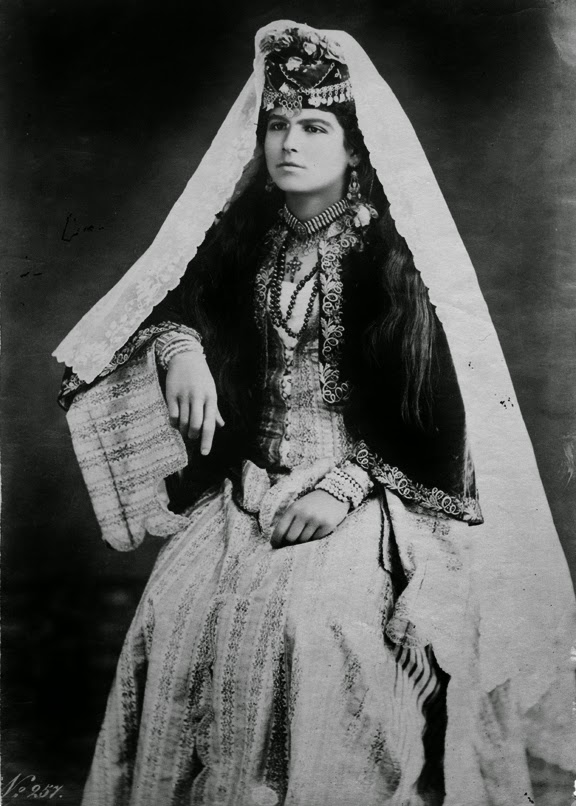
Bonfils, Félix (1831-1885) - 672. Femmes musulmanes Syriennes

Bonfils was by no means the only good photographer of the period; between the time Daguerre introduced his process and the time Bonfils began to take and market photographs, some 200 known photographers were in business - some of them quite good. In Luxor, for example, prints by a man named Beato were on sale, and in Istanbul prints by a photographer named Sebah could be sent home rolled up in metal tubes. But few of them compared to the photography produced by the Bonfils farnily-as Gratien Charvet, founderof the Societe Saentifique et Litteraire in Ales, France, would vehemently argue.

he man who wrote the introduction to the Bonfils' 1878 collection of photographs, Souvenirs d'Orient, Charvet said enthusiastically that the "collection of photographs of the Orient's principal sites - initiated, executed and completed by Monsieur F. Bonfils with unequaled perseverance - should be regarded as one of the most considerable achievements - picturesque, artistic and scientific - of our epoch". 
Arab man smoking pipe, late 1800s. F. Bonfils

Despite this, the Bonfils family had virtually vanished from history by the time that Father Gavin and his staff began to dig into the family history. "All we know of Bonfils", said photographic historian Beaumont Newhall, in answer to Gavin's inquiries, "is that he was a genius".

As recently as two years ago, Gavin wrote in the journal Nineteenth Century: "No one remembers the photographers Bonfils - not even the Sub-Prefect M. Maurice Bonfils - not even the staff of the Evangelical Library in nearby Saint Hippo- Iyte dedicated to collecting biographies of local sons - not even the region's oldest printers and photographers. And at the time of Felix Bonfils', death in 1885, no obituary nor even notice was published in local journals".

Since then, however, Dr. Gavin and his staff have learned a lot about the Bonfils family. In fact, it was two of Dr. Gavin's volunteers - Al and Phyllis Weisman - who first turned up evidence that there was more than one Bonfils photographer: in a New Hampshire barn, they came across the effects of a missionary who had photographic prints signed, "A. Bonfils". "Until then", Dr. Gavin said, "we had found only 'F. Bonfils'".


"They were an incredible family", said Dr. Gavin. They were descendants of Theodore, the emperor of Abysinia, and are related through marriage to the actor Peter Ustinov. One of them, Adrien, was alternately a sergeant brigadier of the Chasseurs d'Afrique, a photographer in his father's studio and a Beirut hotelier. The father, Felix, was the son of a wood-lathe worker, but built up a photographic business with connections in Cairo, Alexandr. ia, Paris and London, as well as Beirut and Ales, the Bonfils home in France. And when Lydie Bonfils, the third photographer, left Beirut in 1916, it was as an evacuee on the deck of the U.S.S. DesMoines.

Litte of that was known at first, but bit by bit over the last 12 years, research by Dr. Gavin and his staff has pieced the story together. It is a story of affection, piety and devotion - to each other and to their adopted homeland, Lebanon - and it begins in the small French town of Ales about 1860 when the family Bonfils set of for Beirut one after the other.

The first to go was Felix Bonfils. Born in 1831, Felix took up the trade of bookbinder, but in 1860 joined General d'Hautpoul's expedition to the Levant to end an outbreak of factional fighting. Evidence suggests that Felix became a photographer sometime after his return from Lebanon, possibly as an amateur. Then, however, when his son Adrien fell ill, felix remembered the cool green hills around Beirut and sent him there to recover. With him went Felix's wife Lydie Bonfils, and when she returned, apparently as enthusiastic about the Middle East as Felix had been, they decided to return en famille.


Photography of Bonfils studio in Beirut, private collection, documentation of Fouad Debbas, TFDC

Since Felix was by then working in Ales as a printer, producing heliogravures - a photographic process invented by Abel Niepce de St. Victor, cousin of the man frequently called "the father of photography", Joseph Nicephore Niepce - he decided to try and support himself in Lebanon by taking up the trade of la photographie. Though it may seem like an odd decision, it turned out well; in 1867, the Bonfils family arrived in Beirut and four years later Felix reported the results of what must have been staggering labor: 15,000 prints of Egypt, Palestine, Syria, and Greece, and 9,000 stereoscopicviews.

Those negatives were made on glass plates, coated with a collodion solution sensitized with silver nitrate. The plates had to be prepared on the spot-usually in a tent in the Middle East, although Francis Frith occasionally used cool tombs and temples as well. Then they were exposed and developed immediately afterwards. Prints could be made later, quite literally by sunlight: paper impregnated with a silver salt solution was stretched against the glass plate in a frame, and then exposed out of doors under direct sunlight.

Though the prints, golden in tone, were beautiful, the photographers had to use eggwhite, or albumen, as a binding agent on the paper and this eventually became unpleasant since the Bonfils family apparently prepared the egg-white themselves. Lydie Bonfils in 1917 was heard to mutter, "I never want to smell another egg again", and supposedly forbade them at her breakfast table thereafter.


Portrait of Lydie Bonfils, private collection, documentation of Fouad Debbas


The process could also be dangerous- particularly in the hot climate of the Middle East. As Frith wrote, "When (at the Second Cataract, one thousand miles from the mouth of the Nile, with the thermometer at 110 degrees in my tent) the collodion actually boiled when poured upon the glass plate, I almost despaired of success".

The second Bonfils photographer was Felix's son, Adrien. Born at Ales in 1861, Adrien was six when the family moved permanently to Beirut Like his father he did military service - as a brigadier in a cavalry regiment in Algeria - but on the death of Felix in 1885, he returned to Beirut to take over the family business, and was soon setting off on new photographic expeditions and launching publishing projects that easily matched Frith's in quality and quantity.

It was Adrien to whom a London agent named Mansell was referring when he wrote, in 1892, to a certain David Gordon Lyon, "I hear from Bonfils that he has made an addition of 150 views to his Egyptian series - shall send these to you when I receive them".


Lind and Adrien Bonfils


Rachel's tomb (circa late 19th century) by Adrien Bonfils.


Adrien Bonfils outside the family's Beirut studio, from which flowered a prolofic output of meticulously processed prints. 
This, says Dr. Gavin's staff, seems to be the first reference to what was becoming the Bonfils collection and to the man who took it upon himself to acquire the photographs: Professor Lyon, the first curator of a new museum in Cambridge, Massachusetts: the Harvard Semitic Museum. Founded in 1899 - with donations from Jacob Henry Schiff of the New York bank ing house of Kuhn, Loeb & Company- HSM, according to its charter, was intended to provide "a thorough study and a better knowledge of Semitic history and civilization, so that the world shall better understand and acknowledge the debt it owes to the Semitic people".

To that end, Lyon began to collect artifacts from the Middle East, particularly the Bonfils photographs. It is not known whether he realized haw valuable they would be in archeology, but it's unlikely. It is only now, Gavin says, that researchers are coming to realize the value of photographs. aLibrarians have leamed to pay careful attention to handwritten notes and diaries, as well as to books and manuscripts. Curators carefully tend sketch pads and ok engravings as 'works of art' But photographs... have until recently remained forgotten".


Bedouin mothers carrying their children on their shoulders. Color photo taken in the late 19th century by the French photographer Félix Bonfils

Nevertheless, Dr. Gavin says, Lyon did work hard at collecting Bonfils photographs. "Lyon's interest was encyclopedic; one can infer from the Mansell note that he's told the agent he wants all the photographs". Furthermore, he nearly succeeded; despite occasional difficulties with U.S. Customs, he secured nearly half of what was available and went on to catalog them, giving them English titles and museum code numbers.

This is known, because Adrien himself had issued three catalogs, organizing 1,684 photographs into nine groups covering Lower and Upper Egypt, Palestine, Syria, Anatolia and Greece. In addition, there was a series of 25 "panoramas" consisting of two or more separate pictures which, when placed side by side, showed broad cityscapes of such Eastern centers as Cairo, Jaffa, Jerusalem, Bethlehem, Damascus and, of course, Beirut. The series was rounded out by a selection of Egyptian views and costumes - including desert scenes and a wedding and a collection of scenes and costurnes of Palestine and Syria.

As these catalogs suggest, Adrierl's output was prolific. But in addition to this expansion of his father's business, he was also experimenting with mechanically colored prints - they were done in Zurich, by the photochromie process - and made four trips to Philadelphia to explore publication opportunities, including a proposed New Testament Illustrated with Photographs, and a book on the journeys of St. Paul.
Meanwhile, the Bonfils family had added a third photographer to its roster: Lydie Bonfils, a fact that emerged when the HSM staff found a reference by an English clergyman named Manning, in his 1874 volume, Palestine lllustrated by Pen and Pencil, to photographers whose prints he used in preparing his own sketches. Among them was "Madame Bonfils of Beyrout".


Young woman from Lebanon, albumin print, attributed to Lydie Bonfils

Lydie, it seems, had decided that mixing albumen for her husband and son was not enough, and apparently got involved in portraits and costume studies in the Beirut studios; descendants, in fact, have confirmed that she worked in the family's Beirut studio for some time after her son abandoned the trade in the early 1900s. There is evidence too that she ranged more widely. In Brummana, a member of the Maksad family told of "Lady Bonfils" stopping a Druze shaikh to pose for her one morning, just after the outbreak of the First World War. And her own photo, according to Nitza Rosovsky, an historian of old Jerusalem, appears in one of the prints in the Harvard cache; she is standing on the pyramid at Giza.

Thus Lydie, despite a growing distaste for eggs, apparently continued the business after Adrien had begun to turn his attention to a proposed medical spa in the mountains of Lebanon - even issuing her own catalog until the First World War forced her removal from Beirut and brought an end to the prolific photographic output of this remarkable family.

By then, however, the work of the Bonfils family was not only extensive, but of an unparalleled quality. Tt is, in fact, an incomparable legacy to both history and art.

Monday, October 6, 2014

الفنان النحات بسام كيرلوس : ما يُنحت هو الأجمل والأعمق


النحت القديم متجذِّر في ذاكرتي

من أعمال كيريلوس من مجموعة متحف فرحات 


ترتبط منحوتات الفنان «بسام كيرلوس»  بالماضي كجزء من ميثولوجيا ذات مدلولات تستجيب لمفاهيم نحتية يسخرها بقوة فعل حركي، لتحاكي حركة الزمن عبر مادة تختلط خاماتها بالافكار التي تتضمن تاريخا، ورؤية تكوينية تتخذ من الكتل الصماء احيانا تجاويف تتميز بمحاكاة الطبيعة،  وبفراغات ذات حركة فيزيائية  تفرض بخطوطها مساحات تتناقض ما بين الظاهر والداخل عبر حركة بناها من  كينونة عناصر  ترتبط بنوعية المادة التي يستعملها، وفق مفهوم نحتي جوهري يتخذ من المرونة صلابته في بناء الاشكال والفراغات والاحجام، بثبات نستقرىء من خلاله المتغيرات الزمنية التي يبتكرها. لتظهر ميثولوجياته متحركة زمنيا،  ونلامس الماضي بصيغة حاضر اشبه بنقطة سابحة في فضاءات مخيلته الباحثة عن التحليق او الابعاد العميقة الرؤيا نحتيا وزواياها الحسية المدركة،  لتوازنات العمل الفني من كافة جوانبه، وبديناميكية تؤثر على الانسجام الداخلي والخارجي للمنحوتة،  وتتابع تفاصيلها بشمولية ذات طابع تجذب الفكر اليها،  ليستوحي من اثارها ميثولوجيا تتناسب وذهنية العمل النحتي الذي يقدمه «بسام كيرلوس» في هذا المعرض،  وبما يتوافق مع الايقاع الزمني والمكاني.  لتتضح عناصر مكوناته وملامستها للطبيعة حيث تكتسب تنويعات مختلفة. مما ينعكس على حركة المنحوتات كل حسب مقاييسها واحجامها واشكالها ومساحاتها، وحتى الطول الاستطيقي لها الذي يحقق بنية اتصالية بمعنى كجسر يصل الماضي والحاضر مع الحركة والسكون ان فيزيائيا بمعناها الخارجي او تمثيليا بمعناها الداخلي المتآخي مع مضمون فكرة كل منحوتة قدمها بأسلوبه القديم الجديد، وهذا يولد تساؤلات كان لا بد من الاضاءة عليها من خلال حوارنا معه عن بعض المفاهيم...

طائر الفينيق المصلوب, من مجموعة متحف فرحات 


* «بسام كيرلوس» والميثولوجيا، متى يبدأ بالنحت واين ينتهي العمل؟ 

- العمل النحتي ليس فقط كتلة ثلاثية الابعاد  يمكن رؤيتها ولمسها، فما لم ينحت هو الاجمل والاعمق. ما وراء العمل النحتي هو ابعاد لا تنتهي للانسان والوجود. لذلك عمل الفنان يبقى عملية تدخل قسرياً للفت النظر وللايحاء، ومحظوظ  الفنان اللذي ينجح في الاقتراب من تلك الحقيقة. بالنسبة لي الحقيقة بدأت بجدية مع الميثولوجيا  ولم تتحقق بشكل منجز مع الدين والفلسفة، وهكذا هو الفن بدأ ويبدأ مع  الميثولوجيا  ويكمل في الدين  ويتوه في الفلسفة، فيتوقف في لحظة غرور الفنان واذعانه بأنه  اكتشف شيئا «ولعل بعض الكبار اكتشفوا شيئا» من الحقيقة  وجعلوا  مشوارنا الى  الشمس اقرب بخطوة. 
* متأثر بالمفاهيم النحتية المعاصرة نوعا ما وتحافظ على الاساليب الكلاسيكية في النحت اين الخطأ والصواب في ذلك؟
- العمل الفني ولا سيما  النحتي لا يكون معاصرا «الا اذا استطاع  ان يختزل كل الازمنة  الماضية  ليستحق ان يكون  معاصرا»  اليوم اللغة  التشكيلية مفتوحة على كل وسائل  التعبير، والفنان مسؤول  عن تاريخ  الفن  قبل ان يكون مكلفاً  بانجاز عمل غير مسبوق، فلا إعادة انتاج الماضي بالامر المشرف، ولا الغرق في موجات رائجة يقدم  خدمة للفن. انما صياغة  تجربة فنية  متجذرة بقالب  يتبنى المفاهيم المعاصرة ويراعي احساس الفنان، يمكن ان ينتج عنه عمل نحتي معاصر وجدي. 
* «بسام كيرلوس» وميثولوجيات برونزية هل تعيد امجاد النحت القديم بلغة عصرية؟.
- الى حد ما، فالنحت القديم متجذر في ذاكرتي ووضعيات الاجساد  التي استخدمت سابقا  نقلتها من تاريخها، ومسحت عنها غبار الامس  لأضعها ضمن اطار معاصر وكأن المشهد هو مزيج  من مضمون قديم  بصورة اطار حديث معاصر.
* هل تعيق مادة البرونز تقنية الآداء ام ان الفكرة قوية في تكوينها وتستطيع تحدي المادة البرونزية؟
- كون مادة البرونز مادة مطواعة وتحتمل التفاصيل الدقيقة، فهي تتوافق مع المواضيع التي اعالجها وبخاصة فكرة الطيران، فالحجر على سبيل المثال  يمكن ان يكون عرضة للكسر  في حال تم اضعاف الكتلة لضرورات التأليف. بالنسبة لي، خصائص البرونز كمادة معدنية قوية ومتماسكة بما يكفي، تسهل ابراز تفاصيل دقيقة في العمل النحتي، اضافة الى خصوصية  هذه المادة  النادرة في التاريخ، فهي تستحضر الماضي ببلاغة.

الأم المنتحبة, من مجموعة متحف فرحات


* تختلف انواع الفراغات في اعمالك ما الهدف من ذلك؟ 
- ان عملية تزاوج الكتل الممتلئة  بالمساحات الفارغة في النحت  تشبه عملية  تشابك الكواكب  بالفضاء، فلا هذا الاخير جذاب بانعدام  المجرات ولا هذه  الاخيرة مهمة بانفرادها . اذأ الفراغ هو جزء ضروري في العمل النحتي. 
* لمست  في بعض المنحوتات كتلة صماء برز فيها  بعض التجاويف. ماذا تقصد  بذلك؟ 
- ان بروز بعض التجاويف هو تأكيد على تبيان المساحة المشغولة وكأنها خام، بينما  الاجزاء الاخرى فهي مشغولة اكثر، ترمز هذه العملية الى انبثاق الروح من المادة. هذا اولا أما ثانيا فتترك التجاويف اثرا عميقا للمتلقي وتأخذه الى التجاويف التي  ترسسمها الطبيعه على الاشجار  وخاصة  الزيتون منها  التي نجدها بكثرة في بلدتي. 


حاورته: ضحى  عبدالرؤوف المل
dohamol@hotmail.com

Selection of Sculptures from the Farhat Art Museum, Quizas Quizas Quizas...